
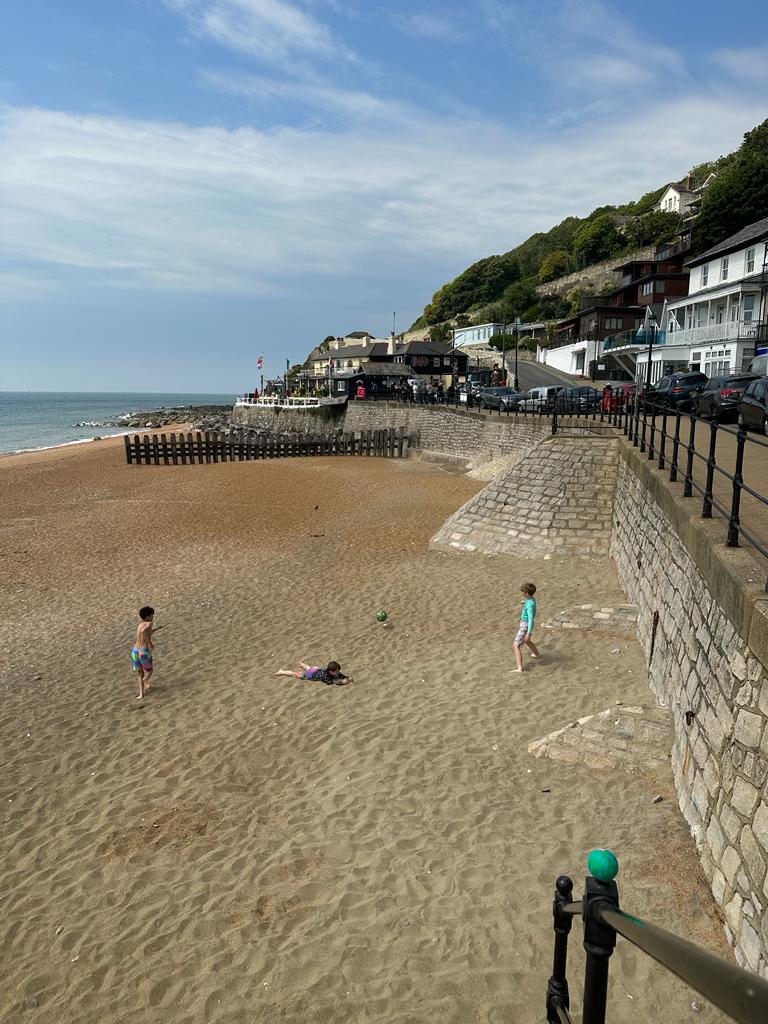
The Isle of Wight is known as the Holiday Isle. It’s bigger than you might think at around 24 miles wide and twelve miles from north to south, the largest in England. The southernmost town is Ventnor, nestled under the highest point of the island on St. Boniface Down. The railway reached here in 1866, with a tunnel through the hillside and terminating on a ledge above the town at 294 feet above sea level. So it was never the most accessible of stations, even when joined by a second line into Ventnor West which operated from 1900 to 1952.
The line was cut back to Shanklin in 1966, and it still runs from there to Ryde Pier Head, where the catamaran arrives over the Solent from Portsmouth Harbour station, terminating point for trains from London Waterloo. There is also an alternative route to Ryde from Southsea using the highly unusual Hovercraft service between Ryde Esplanade and Southsea. I arrived on the catamaran at the Pier Head and spent some time in Ryde before going to my hotel at Seaview.
The Isle of Wight has resorts that have been popular holiday destinations since Victorian times, known for its mild climate, coastal scenery, and verdant landscape of fields, downland and chines.
I have never explored the east side of the island and stayed at Seaview during a sailing competition that I was supporting. However, I skived off for a few hours on the bus to Ventnor and to take a ride back on the Isle of Wight railway, an electric railway which until recently was run by 1938 tube stock but is now run with former District Line stock also from London.
Ventnor is steep with many zig-zag roads, one named Zig Zag Road. Once on the promenade, there is a pleasant sandy beach and a children’s paddling pool dominated by a big map of the IoW. I always remember that, as an eight-year-old, the contoured map had to be walked over with care since it was often slippery, but now it has more of a safer matt surface.
At the north end of the promenade is one of my favourite pubs: the nautically themed Spyglass Inn which serves seafood and a large array of pub specials. The management knows they have an incredibly attractive pub, and this is duly reflected in the prices, but with splendid views over the beach and sea and some excellent real ales to accompany the food, it doesn’t seem a rip-off. The biggest decision is whether to sit inside or outside when the weather is fine.
Ventnor is small, with only a population of 5,800. But it does have a thriving arts scene. If staying on the island for a few days, Ryde or Sandown may be a better bet for somewhere to stay if relying on public transport, which avoids the problem of parking when moving around the island, and the cost of the ferries which know they have a captive market. Both these resorts are on the single Island Line.
St John’s Road station, where the depot is, is close to the Isle of Wight bus and Coach Museum, housed in an old Southern Vectis bus garage, with loads of green vehicles interspersed with several examples of coaches that ran excursions for tourists attracted by painted chalkboards outside their various offices. These excursions have now disappeared but the efficient, reliable, and cheap services enable easy travel around the Island. As elsewhere in England, the £2 maximum fare applies to the end of October, then rises to £2.50 for a year.


