
In late October I found myself for two days in a four-star hotel in southern Leicestershire. It was a thirty minute walk from the nearest bus stop in North Kilworth, ten minutes down the hotel drive and twenty minutes along a fast A road with no pavements, jumping out of the way of approaching lorries. There are often much better options close to railway stations and I estimate that there are about 400 stations which have hotels close at hand. Therefore, I am working on a list of hotels ideal for the rail traveller. The nearest railhead to North Kilworth was Market Harborough, which I reached from the northeast with changes at York, Derby and Leicester.
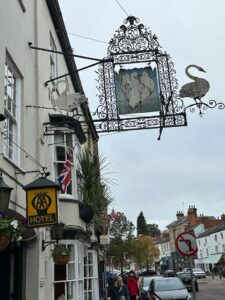
There is a bus route, the 58, to North Kilworth, but I had only nine minutes to catch it from my on-time arrival at Market Harborough. I could track the bus perfectly on bustimes.org, but I took the wrong turn off the platform, costing me precious minutes on my dash into town. I can quantify how much that cost me: £31.70 by taxi instead of £2 on the bus, and although I enjoyed my stay in the four-star hotel, I would rather have been in the cosy and fully refurbished Three Swans Hotel in Market Harborough which even had one of the old yellow AA signs denoting its three-star status.
On the Friday, I took a ride on the 58 bus to Lutterworth, which was an old coaching town in the days before the railways, which was around 1750-1850. There are three left, but the most authentic is the Greyhound (pictured). Two famous people hailed from Lutterworth. Firstly, John Wycliffe who was Rector in the town and who translated the Bible from Latin into English. This was several centuries before Aldred translated the Gospels in Chester-le-Street around 970, but, to be fair, Wycliffe did the whole Bible. Secondly, Sir Frank Whittle who first patented and built the jet turbine engine, whose story is told in the excellent, if small, Lutterworth Museum.
The mainline railway came late to Lutterworth, in 1899 with the arrival of the Great Central Railway from London Marylebone. It was also the first to close in 1969, so Lutterworth is not a good place to stay for the rail traveller, but it’s an interesting place to explore for a couple of hours by bus (and probably no more) which is why the two-hourly bus service back to Market Harborough is so handy.
There’s an old grammar school on stilts in the centre of the town of Market Harborough, built to accommodate the butter market beneath, and it’s next to the church of St. Dionysius the Areopagite, which is an unusual dedication to one of the Athenian converts of St. Paul. Coffee and a chat were on offer on Saturday morning when I was on my way to the railway station, but unfortunately, I did not have time.
The museum was also a casualty of my journey from the wilds, so I missed seeing the Hallaton Treasure which was the largest hoard of Iron Age coins ever found. The return journey involved a short visit to Leicester, home of the Richard III centre, with subsequent changes at Sheffield and York and a punctual arrival back home.