
Kent is a large county, and Deal in the east is 88 miles from London Charing Cross. Arriving at the Kent coast resort in the late afternoon, I looked at the orientation map at the station to get my bearings. I knew my hotel was close to the pier, but surprisingly no pier could be seen on the map. Surely even a bit of a pier jutting out into the sea could be shown, so somewhat confused I headed east to the coast through the town centre. I knew I was staying at the Waterfront Hotel at 29, Beach Street. That would suggest a coastal location! I found it easily, and was directed up the stairs to the attic where my small but comfortable room was located. I was not there long as I wished to explore the town, and the pier (which was reassuringly present all along, within 50m of the hotel).
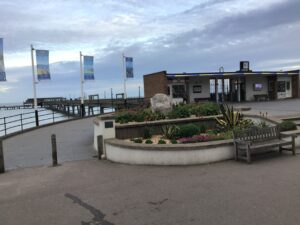
The pier was built in the mid 1950s, and looks it, but has been refurbished recently, with an end of the pier café looking over the junction between the North Sea and the English Channel. It has all the attributes of a pier end café short of actually being open, and I knew I could not return the following day as I had two castles to visit. The pier has a lower deck which is latticed metal through which the water can pass through, which at other times can be used as a platform for fishing. High tides do not damage the pier, and the anglers can get close to the water.
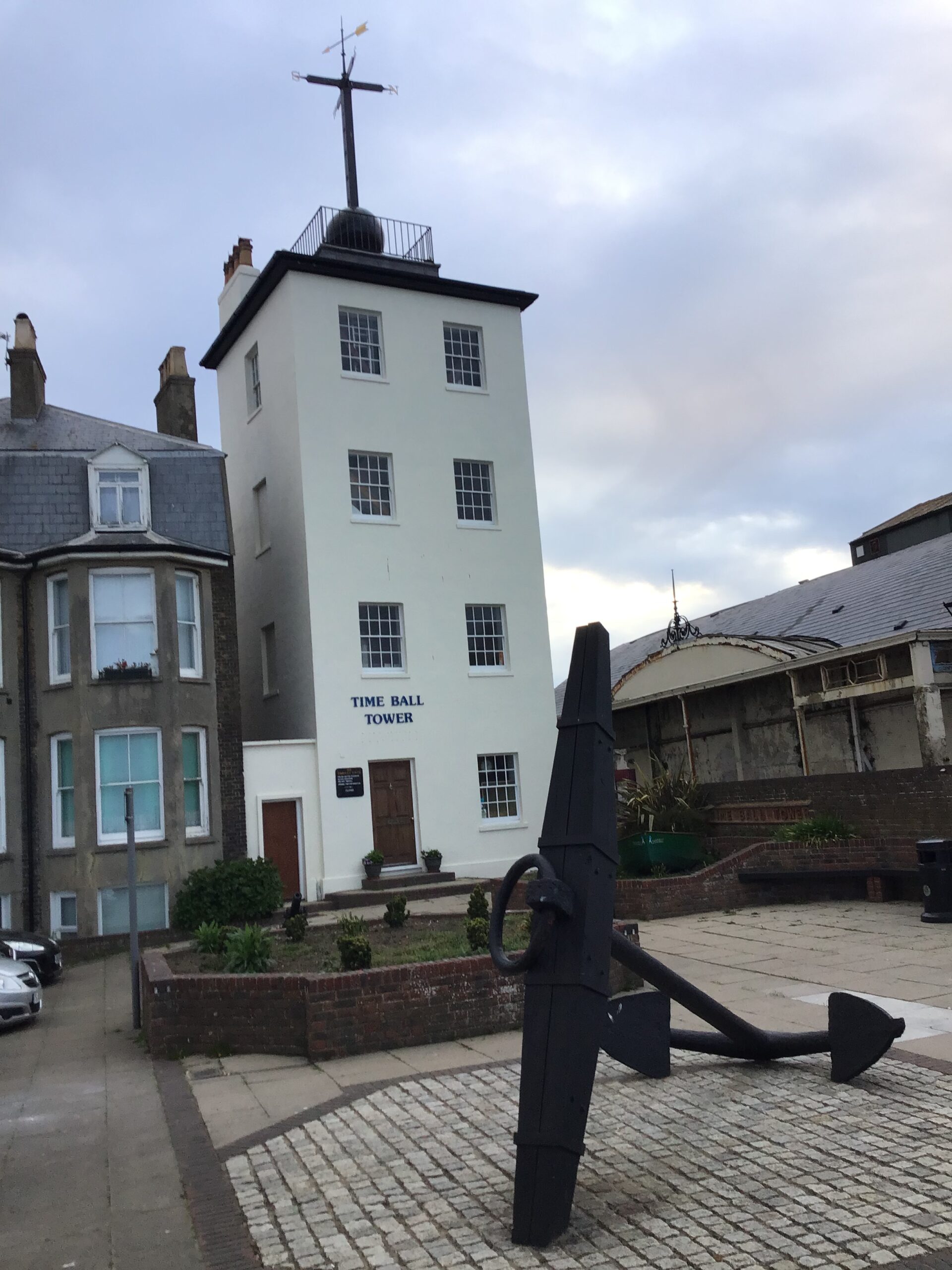
There’s a wide shingle beach, so not particularly conducive to swimming. The next resort up is Sandwich (supposedly twinned with the French resort of Baguette!) and as darkness fell I chose to eat in the Royal Hotel, where I had previously booked to stay until I found the less sumptuous but much cheaper Waterfront. Excellent seafood, as might be expected. I also found the Time Ball Tower which sent a signal at one o’clock for vessels in the Channel. Privately run, it has a signal sent by the Southeastern Railway from Greenwich over the telegraph network.
People have not always been complimentary about Deal. Samuel Pepys, writing in 1660, called the town “pitiful”. Daniel Defoe in 1704 wrote a libellous poem, and William Cobbett passing through in September 1823 noted in his book Rural rides
Deal is a most villainous place. It is full of filthy-looking people. Great desolation of abomination has been going on here; tremendous barracks, partly pulled down and partly tumbling down, and partly occupied by soldiers. Everything seems upon the perish. I was glad to hurry along through it, and to leave its inns and public houses to be occupied by the tarred, and trowsered, and blue and buff crew whose very vicinage I always detest.
Things improved with the arrival of the railway, and the Southeastern railway had a large hotel in the town, now rebuilt as private flats. In the morning a walk south took me to English Heritage’s Walmer Castle, which is the official home of the Lord Warden of the Cinque Ports. This was one a position of Queen Elizabeth, the Queen Mother, since whose death in 2002 the role as passed to Admiral of the Fleet, Baron Boyce. Walmer Castle was a defensive position, as well as a residence with a fine and extensive garden. I returned to Deal which is a smaller E.H. Castle containing much information about the Tudor period from when it was built, and on collecting my luggage from the hotel went to the station for the High Speed Javelin service to St. Pancras.


