
You have a choice to reach Chatham from London, central one of the three Medway Towns. Either the “classic route” from London Victoria, or the High Speed Service from St. Pancras which runs down HS1 shared with Channel Tunnel trains to Ebbsfleet international where it joins the conventional line. The latter is little more expensive but saves time and often a tube transfer.
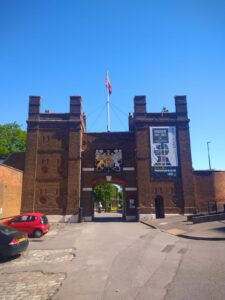
Outside the station at Chatham is a large sign directing you to a walk to the Chatham Historic Dockyard, which is a mile away and a 30-minute walk. Whilst this is indeed true, just round to the right is a small bus terminal and from here buses 1 and 2 operated by Arriva go to the Dockyard much quicker. It depends whether you want to walk through the town or not, which I did, but more time at the Dockyard would have been better. You can’t use the stunning entrance to the dockyard which is pictured, because pedestrians have to enter and pay the same way as the car passengers. This involves a walk downhill and across a car park to the left. I used the bus on the way back to the station.
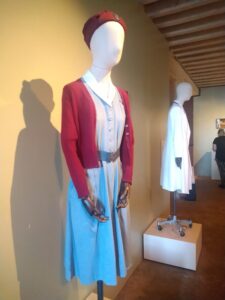
So why was I in Chatham on 9th June at all? It was to make use of a pre-pandemic booking for a “Call the Midwife” tour of the Historic Dockyard, to see some of the locations used in the popular BBC Sunday night drama. To be honest, some of the reviews of this tour are clearly written by people who have no idea about modern television production, expecting to see Nurse Crane’s Morris Minor parked on the corner or having afternoon tea with Jenny Agutter in Nonnatus House. I enjoyed the 90-minute tour and the guide, dressed in the appropriate midwife uniform was friendly and very knowledgeable about the programme. To fans of CTM, go to CTM which is also the railway’s code for Chatham!
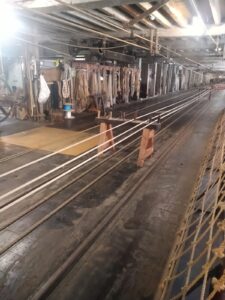
It’s a real community in the Dockyard. 400 people live there, and 110 businesses are based in the Dockyard. I once commissioned a hovercraft there for a youth centre in North Shields. There are many maritime attractions including WW2 destroyer HMS Cavalier, cold war Submarine HMS Ocelot and the Gannet, a Victorian sloop. On the north side of the site in pump house 5 is the Copper Rivet gin distillery. I found a fascinating display of RNLI’s Historic Lifeboats Collection, and until the end of October there is an exhibition called “Hidden Heroines”, the stories of women associated with the dockyard. The photograph shows a small portion of the working ropery on the site, still producing ropes in an attraction which labels itself “your big day out in Kent”.
Fort Amherst is another attraction in Chatham which you pass on foot or on the bus from Chatham station to the Dockyard. This is free to enter, a Napoleonic fort which was used for civil defence purposes in both world wars. The fort is run by the Fort Amherst Heritage Trust and is located in 20 acres of parkland. The tunnels in the fort date from the 1790s and tunnel tours are usually at 1100 and 1330 costing £7.50 for adults and £5 for children. So, if you want to do both, it’s best to do the tunnels at Fort Amherst first, and spend the afternoon until closing time at the Dockyard. The Dockyard admission is £22 for adults, £13 child with repeat admission without further charge for a year. The Call the Midwife tours include dockyard admission for the day, but not repeat visits, and cost £25.
www.thedockyard.co.uk www.fortamherst.com